
How bike gears work—and when to shift
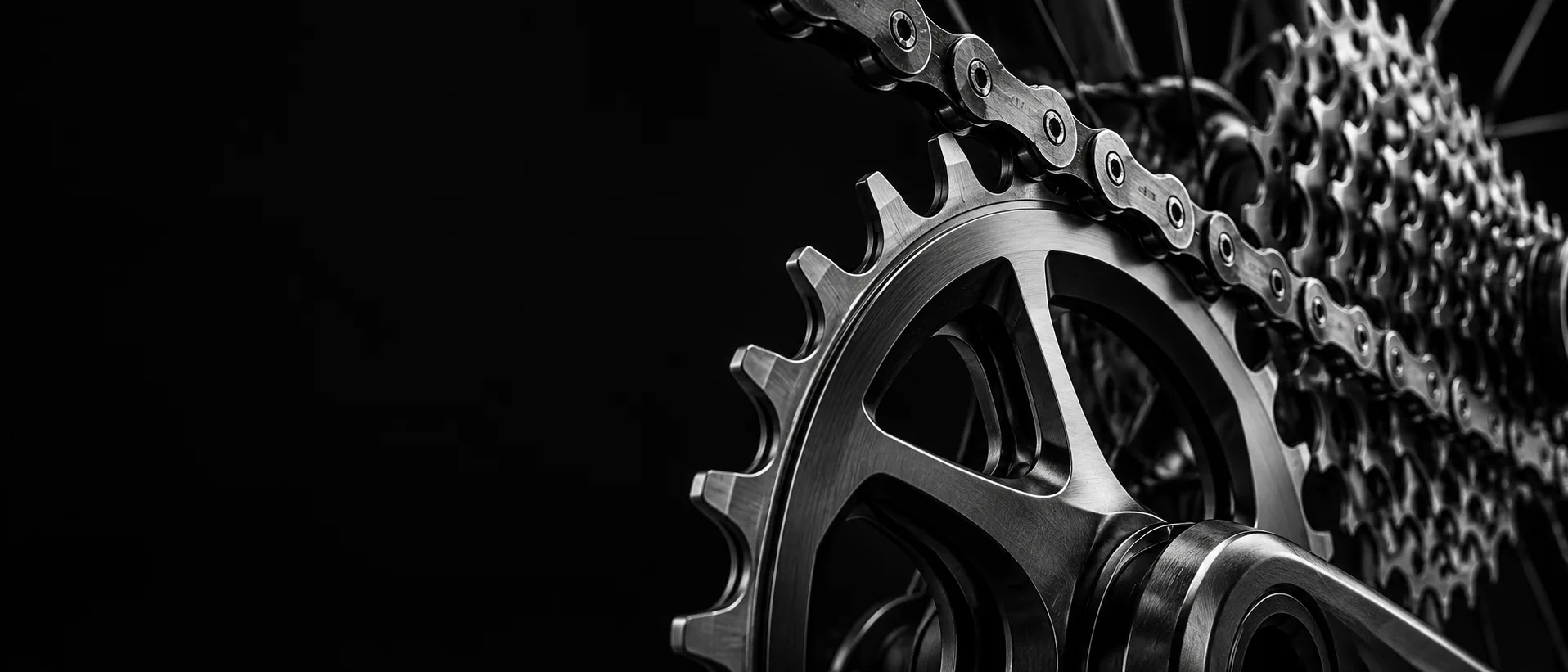
Why a gear makes pedalling easier
A gear trades distance for pedal force. In an easier gear, one turn of the pedals moves the bike a shorter distance. To travel the same distance you make more pedal turns, but each turn needs less force to produce the same driving force at the rear wheel.
Think of the chain as a loop being pulled by the front chainring. Each tooth takes one link of chain past a point. The rear sprocket turns as that same chain passes over it. The number of teeth at each end determines how far the wheel turns.
See what happens when you shift
Choose a chainring and a rear sprocket. Follow the chain from the cranks to the rear wheel.
The selected combination keeps the chain away from the opposite extreme. Try 50 / 34 or 34 / 11 to see cross-chaining.
Illustrative 50/34 chainrings and 11–34 cassette. The drawing exaggerates lateral spacing to make chain angle visible. Speed assumes 90 rpm, a 2.10 m wheel circumference and no slip; it does not predict the effort needed.
The drivetrain on the bike
Rotate the model to see the crank, pedals, chain and rear sprockets. It shows a fixed gear; the chainline illustration above is a separate example.
Why a gear makes pedalling easier
A gear trades distance for pedal force. In an easier gear, one turn of the pedals moves the bike a shorter distance. To travel the same distance you make more pedal turns, but each turn needs less force to produce the same driving force at the rear wheel.
Think of the chain as a loop being pulled by the front chainring. Each tooth takes one link of chain past a point. The rear sprocket turns as that same chain passes over it. The number of teeth at each end determines how far the wheel turns.
Why a smaller front chainring is easier
Turn a 50-tooth front chainring once and it pulls 50 links of chain. With a 25-tooth rear sprocket, those 50 links turn the rear sprocket and wheel twice. Change only the front to 34 teeth: one pedal turn pulls 34 links, so the same rear sprocket turns 34 ÷ 25, or 1.36 times.
The smaller front ring pulls less chain per pedal turn. The wheel travels less distance, and the crank has more leverage over the wheel: for the same road resistance, less pedal torque is needed. You pedal more revolutions to cover the same ground.
Why a larger rear sprocket is easier
Keep the 50-tooth front chainring. One pedal turn still pulls 50 links. A 25-tooth rear sprocket needs 25 links to turn once, so it turns twice. A 50-tooth rear sprocket would need all 50 links for one turn: the wheel turns just once.
The larger rear sprocket needs more chain to complete a turn. It also gives the chain a longer lever around the rear axle, producing more wheel torque from the same chain tension. The wheel travels less distance per pedal turn, so less pedal torque is needed for the same road resistance.
The trade-off on a climb
With a 2.10 m wheel circumference, 50/25 moves the bike about 4.20 m per pedal turn; 34/25 moves it about 2.86 m. To cover the same distance in the lower gear, you turn the pedals about 47% more times, with about 32% less crank torque for the same wheel torque, ignoring losses.
At the same speed and on the same hill, the bike still needs roughly the same power. The easier gear reduces the push needed on each turn but requires faster pedalling. If you keep the same cadence instead, the bike moves more slowly. Use the controls below to change one cog at a time and see how far each turn takes you.
Why avoid cross-chaining?
On a double-chainring bike, big chainring with the biggest rear sprockets, or small chainring with the smallest rear sprockets, puts the chain at a pronounced sideways angle. The extra sideways deflection can increase friction and may cause noise or rubbing at the front derailleur. How much it affects wear depends on the components and riding conditions.
Try both combinations above. A shift to the other chainring and a different rear sprocket can give a similar ratio with a straighter chain. The ratios will not always match exactly. Shift before the climb becomes too steep and ease pedal pressure briefly while the chain moves.
What if the chain rubs?
A slight rub can occur when the front derailleur cage is close to the chain. Some front shifters have a trim position that moves the cage slightly without a full chainring shift; other systems adjust automatically or use a different design. Check the instructions for your specific drivetrain.
If noise persists across sensible gear combinations, the drivetrain may need inspection or adjustment. Do not force a shift or assume every sound is cross-chaining.
How to choose a gear on the road
Before a climb, shift towards a larger rear sprocket while still pedalling. If you are running out of easier rear gears, move to the smaller front chainring; a rear shift in the other direction can soften the change in cadence.
On flatter or faster roads, the larger chainring and smaller rear sprockets provide higher gears. Choose a comfortable cadence for the terrain. Shifting changes the trade-off between pedal force and cadence; it does not make the hill disappear.
Your drivetrain may be different
A 1x bike has only one front chainring and is designed to use its full rear cassette. Do not apply the two-chainring big/big or small/small rule to it. Cassette range, front derailleur trim, electronic shift restrictions and component compatibility vary by system.
Some electronic systems prevent particular combinations; others permit more combinations without cage rub. Follow the component maker’s guidance. Chain length and derailleur capacity must cover the fitted gears, even if you normally avoid an extreme combination.
Why two combinations can feel almost the same
Gear ratio is front teeth divided by rear teeth. A 50/34 combination gives about 1.47 wheel turns per crank turn, while 34/24 gives about 1.42. The second is slightly easier and puts the chain on a different path; it is not an exact match.
This overlap is useful when approaching an extreme chainline. Move to the other chainring, then choose a rear sprocket that brings cadence back toward where you want it. The best choice depends on the actual cassette and terrain.
What the rear derailleur is doing
The rear derailleur guides the chain from one sprocket to another and uses its spring-loaded cage to take up changes in chain length. Moving to a larger rear sprocket requires more chain around the sprocket; moving to a smaller one leaves more slack for the derailleur to manage.
That is why chain length and derailleur capacity matter, even for combinations you usually avoid. The top-view diagram illustrates chain angle, not the full derailleur motion or an installation procedure. Check the component manufacturer’s specifications before changing parts.
A practical sequence on rolling terrain
As a climb approaches, shift the rear one sprocket at a time while you are still pedalling, rather than waiting until the pedals become difficult to turn. If the slope continues and you need a larger change, shift to the smaller front chainring and then adjust the rear to settle back into a comfortable rhythm.
On a descent or faster flat, use a harder combination when it helps you keep a comfortable cadence. Avoid forcing a shift under a heavy push, and remember that shifter operation varies across bikes.