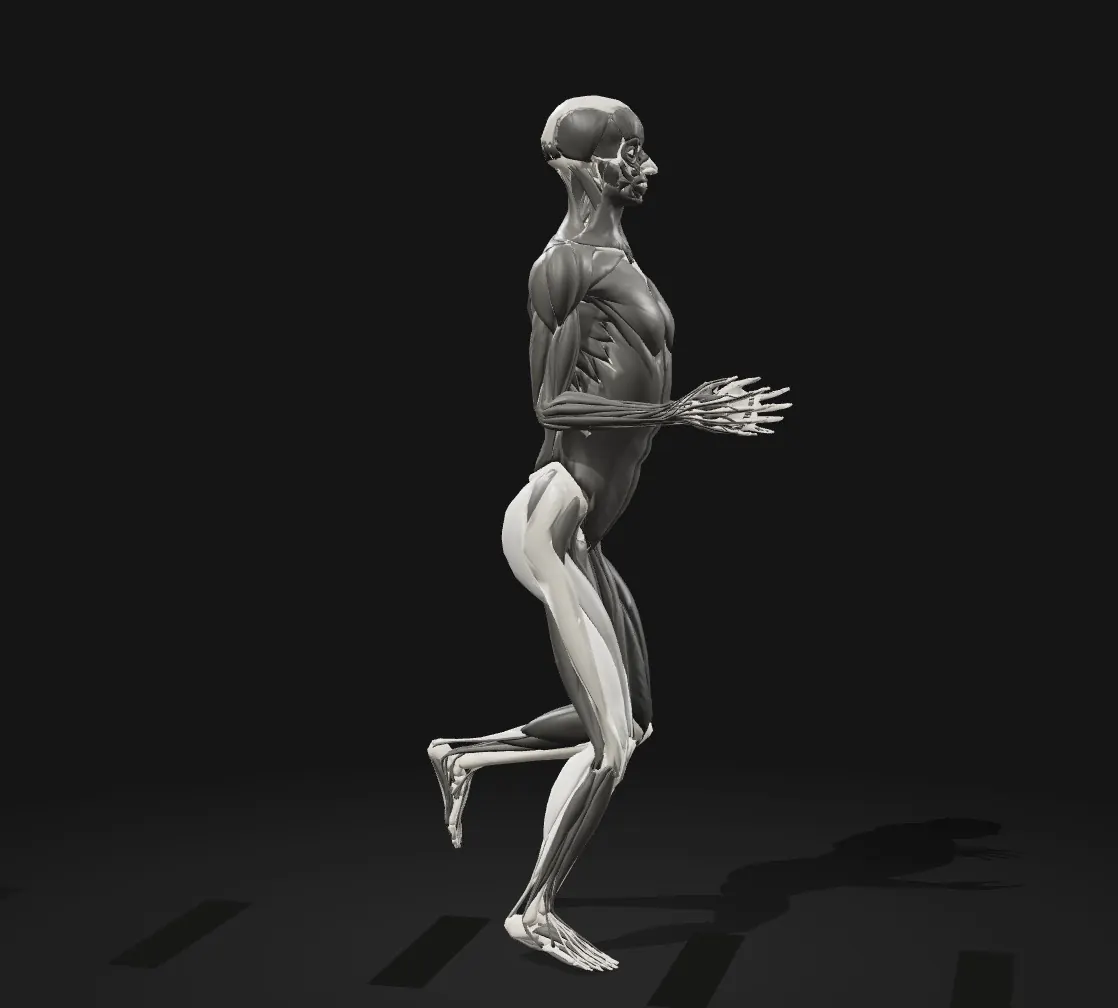
Know which muscles drive each part of the stride and the pedal stroke, and which ones cross two joints.
Show it for
01 / 05
0% landing
working hard working lightly · Timing from published muscle-activity studies; individual riders and runners vary. Anatomy adapted from Z-Anatomy and BodyParts3D (DBCLS), CC BY-SA 4.0.
Lit means working. Tap a muscle or a row to follow it through the stride.
STEP 1 OF 5
One cycle, eight muscle groups
A stride is one full cycle of one leg: foot down, push off, fly, swing through and reach for the ground again. At easy pace it takes about 0.7 seconds, and the foot is on the ground for under 40% of it.
Lit means working. Press play and watch the work arrive in waves: the big extensors around landing, the hip flexors and hamstrings in the swing.
THE TAKEAWAY
Each muscle switches on and off at the same points in every cycle.
Read the whole lesson
01 · One cycle, eight muscle groups
A stride is one full cycle of one leg: foot down, push off, fly, swing through and reach for the ground again. At easy pace it takes about 0.7 seconds, and the foot is on the ground for under 40% of it.
Lit means working. Press play and watch the work arrive in waves: the big extensors around landing, the hip flexors and hamstrings in the swing.
The takeaway: Each muscle switches on and off at the same points in every cycle.
02 · Stance does the work
From landing to push-off, the glutes, quads and calves carry you. They absorb the landing, hold you up and drive you forwards, all in about a quarter of a second.
The soleus, the deep calf muscle, takes the largest force in the step, several times body weight through the Achilles tendon.
The takeaway: The biggest muscles work together in one short window.
03 · Muscles that cross two joints
The rectus femoris, hamstrings and gastrocnemius each cross two joints. They can pass energy from one joint to the next rather than only making it.
Watch the hamstrings at the end of the swing: the hip is bent and the knee is straightening, so they are stretched while they work to slow the lower leg down.
The takeaway: Two-joint muscles work across a longer part of the cycle than one-joint muscles.
04 · The swing is fast, not free
After push-off the hip flexors whip the thigh forwards and the shin lifts the foot to clear the ground. The faster you run, the harder this part becomes.
Late in the swing the hamstrings brake the lower leg, so the foot lands under the body, not out in front.
The takeaway: The recovery half of the cycle still has muscles working; they are just lighter jobs.
05 · Same muscles, different jobs
Both sports use the same muscles, but not in the same way. Riding keeps most of the work in the downstroke, with the muscles shortening as they push. Running splits it between a heavy landing and a fast swing.
The table compares every muscle from the same model the figure uses. The last column is the one the next lesson is about.
The takeaway: Same anatomy, different timing and a very different type of work.