Explain why a run and a ride of the same effort cost your legs differently, and what that means for building run volume.
Show it for
02 / 05
8% loading
working working while lengthening · Timing from published muscle-activity studies; individual riders and runners vary. Anatomy adapted from Z-Anatomy and BodyParts3D (DBCLS), CC BY-SA 4.0.
Thigh
Vastus lateralis & medialis
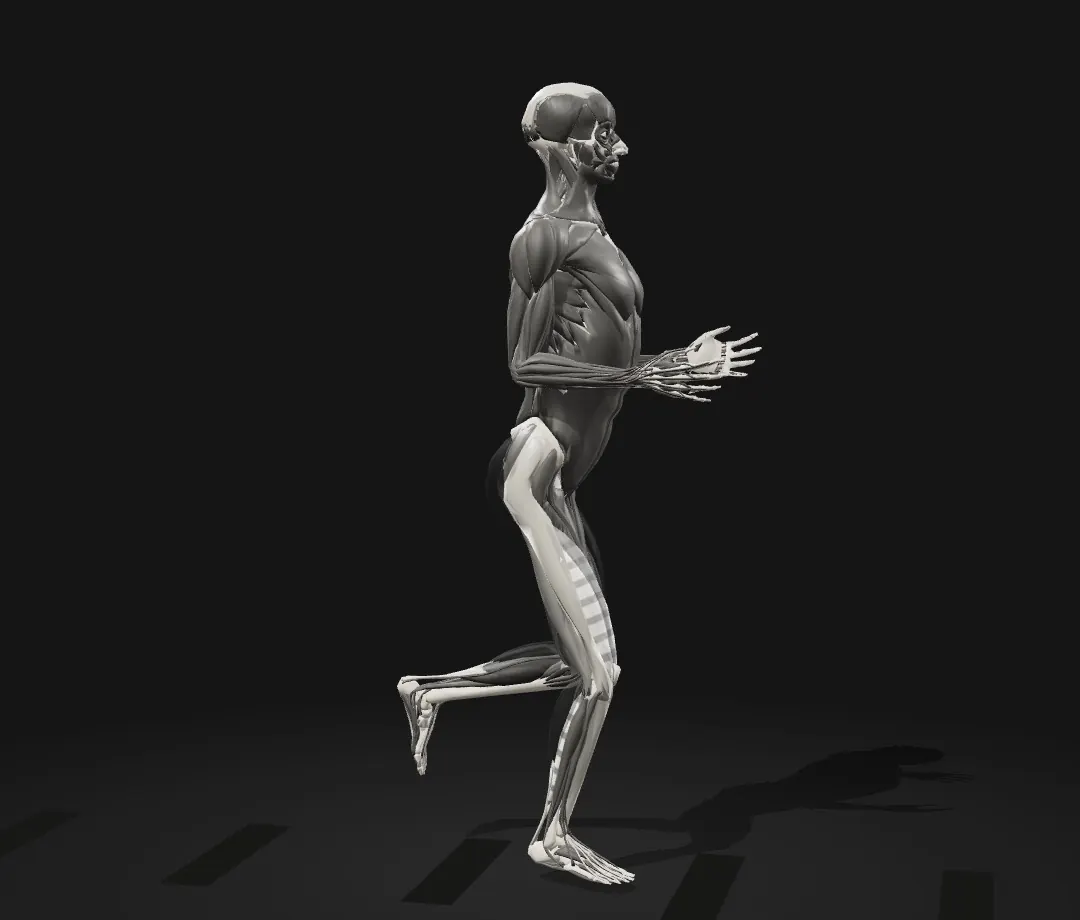
Take the landing. They work while the knee bends under you, which stretches them under load, then help straighten it again.
Right now
Working hard while being stretched
Work done while lengthening
62% of its activity
STEP 1 OF 5
Working while being stretched
A muscle can work in three ways: shortening, holding its length, or lengthening while it resists. Lengthening work, which physiologists call eccentric, is the one that causes most of the soreness and damage after unfamiliar exercise.
In the running figure, dark bands stream along a muscle whenever it is working while being stretched. Watch the quads and calves at landing, and the hamstrings at the end of the swing.
THE TAKEAWAY
Every landing stretches the quads and calves while they carry you.
Read the whole lesson
01 · Working while being stretched
A muscle can work in three ways: shortening, holding its length, or lengthening while it resists. Lengthening work, which physiologists call eccentric, is the one that causes most of the soreness and damage after unfamiliar exercise.
In the running figure, dark bands stream along a muscle whenever it is working while being stretched. Watch the quads and calves at landing, and the hamstrings at the end of the swing.
The takeaway: Every landing stretches the quads and calves while they carry you.
02 · Same quads, opposite jobs
Switch between Run and Ride and follow the quads. On the bike they shorten as they push and rest on the way back up. On the run, most of their work happens while the knee bends under you at landing.
In this model the main quads do none of their work while lengthening on the bike, and about two-thirds of it when running. The soleus goes from almost none to nearly half.
The takeaway: The same muscle can do completely different work in each sport.
03 · Two and a half body weights, every step
At easy pace the ground pushes back with about 2.5 times your body weight on every step, around 85 times a minute on each leg. Faster running pushes that higher.
A pedal stroke at a solid 200 W needs about a third of your body weight. Move the sliders: even big power or a low cadence stays well below a single running step.
The takeaway: Running loads each leg with several times more force than riding does.
04 · Your engine adapts faster than your legs
Heart, blood and muscle metabolism respond within weeks. Tendon and bone respond too, but over months, because their collagen and mineral are rebuilt slowly.
That gap is why runners get hurt when fitness runs ahead of their legs: the aerobic system says yes before the tissues are ready. Increase the weekly ramp and watch the gap open.
The takeaway: Fitness can outpace tendon and bone, and that gap carries risk.
05 · What this means for your week
Build run volume more gradually than your fitness would allow, and keep easier weeks in the block. There is no universal safe percentage; the gap depends on you and your history.
Soreness two days after a harder or longer run is typical lengthening damage. Sharp, localised or worsening pain is not something to train through; get it assessed.
The takeaway: Ramp running on the tissues’ timeline, not the engine’s.