
Choose a training method
Seven training philosophies and four seasonal structures, and what changes when you pick one.
Updated 4 November 2026
Form can write your sessions to a training method. There are two separate choices: a training philosophy, which is what a normal week looks like, and a season structure, which is whether the training changes through the year. Both are optional. With nothing chosen, the coach uses its own judgement. This article says where to choose them, what each one is, and what changes when you do.
Where to find it
Choose your method
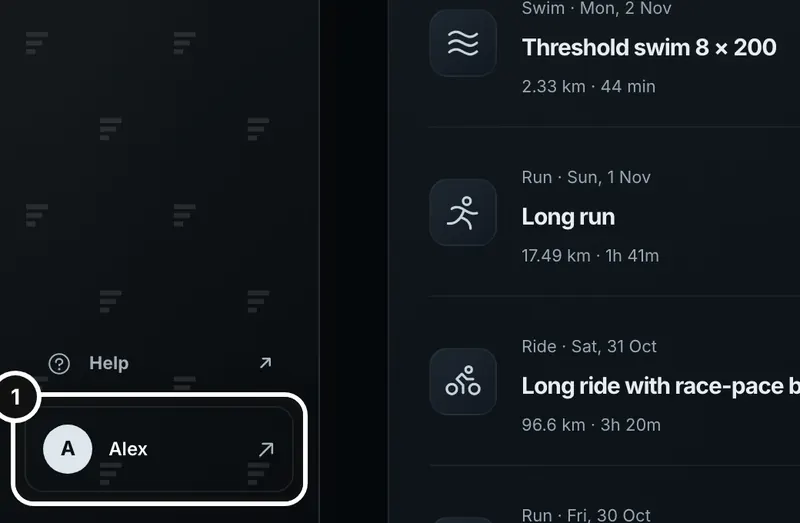
1Click your name at the bottom of the left sidebar to open Profile & settings.
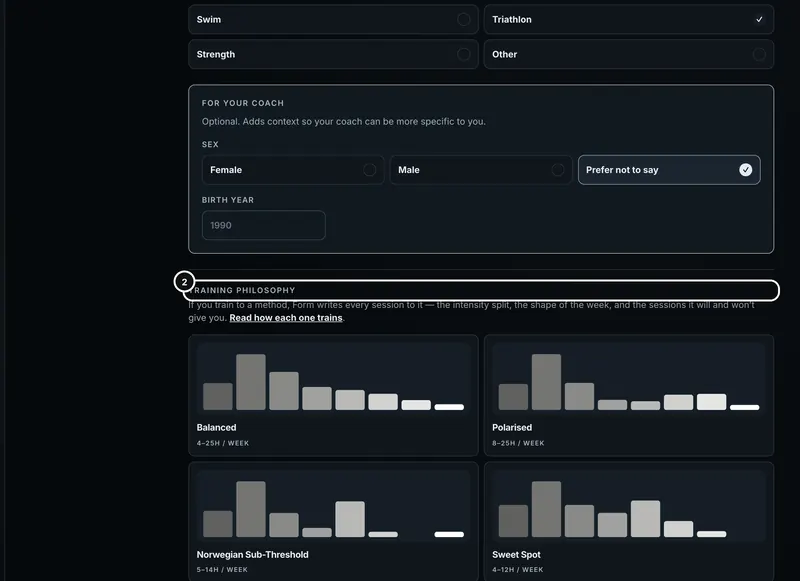
2On the Profile tab, scroll past For your coach to Training philosophy and pick a card.
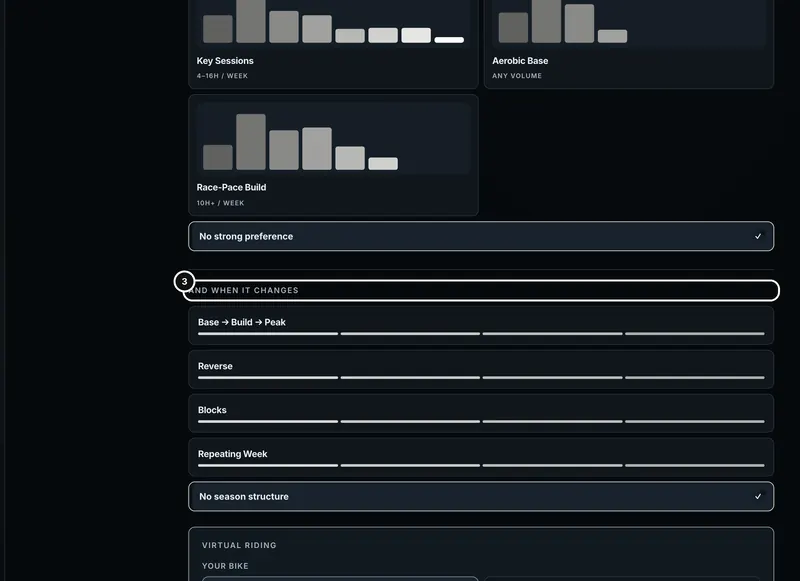
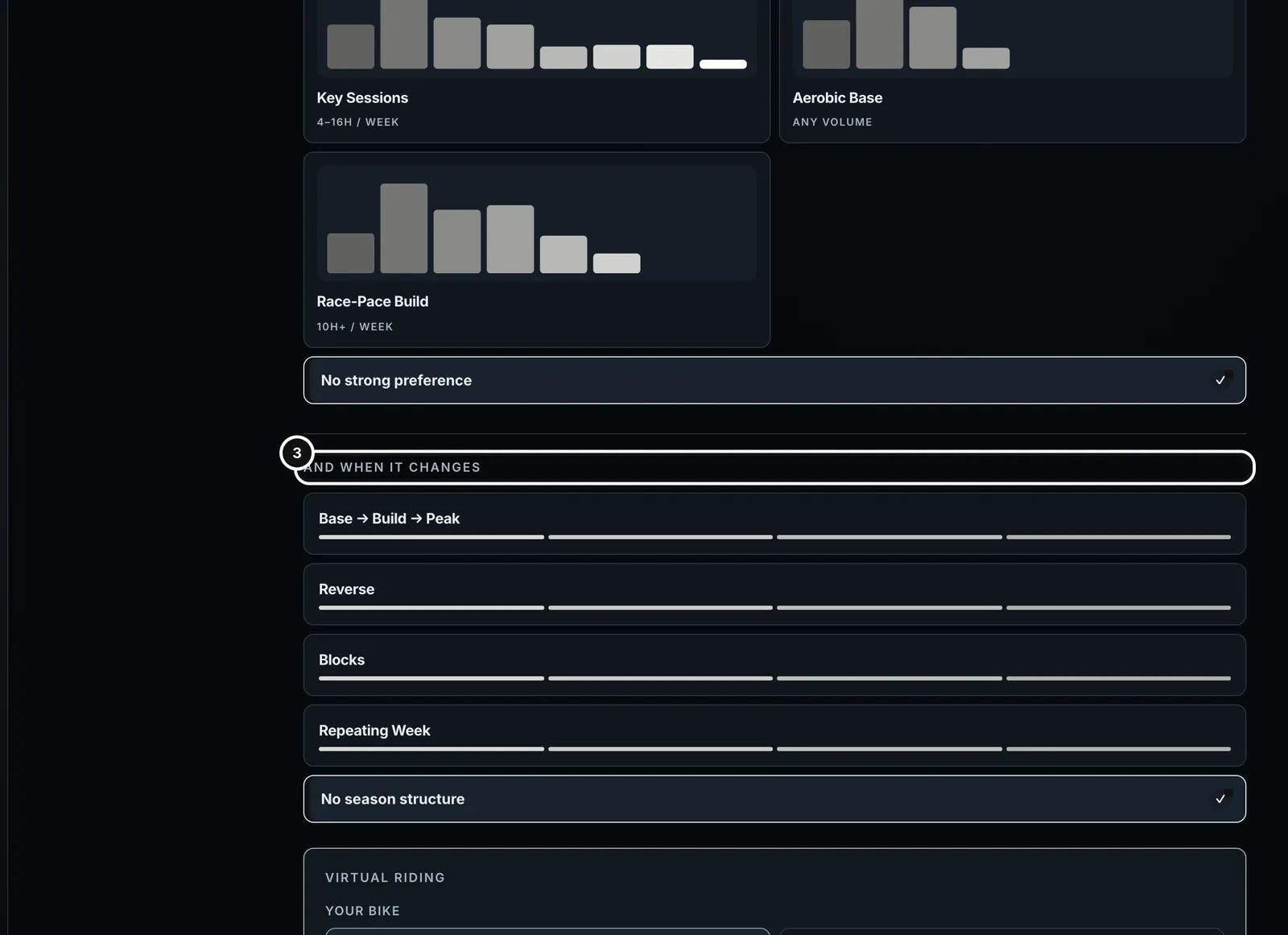
3Under “And when it changes”, pick how your season is structured. Then press Save changes at the bottom of the page.
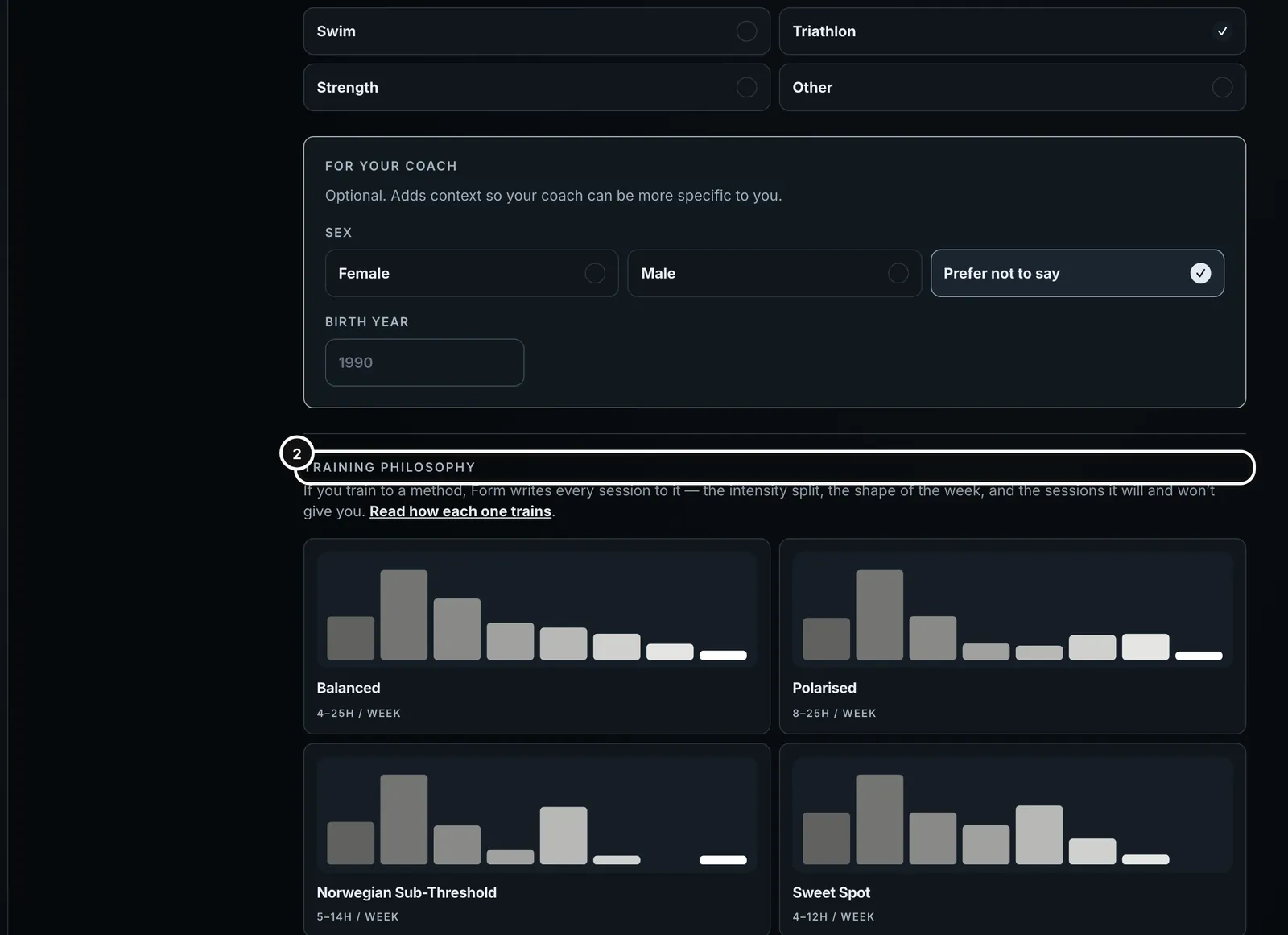
Just above the pickers, For your coach asks for your sex and birth year. Both are optional and separate from your method: they give the coach context, and choosing a method does not depend on them.
New athletes meet the same two choices in setup, step 3 (Your numbers). It asks “Do you follow a training method?”. Answer “No, my coach decides” to leave both empty, or “Yes, I’ll pick one” to open the pickers.
The seven training philosophies
Each card shows a bar chart of how the method spreads effort from easy to very hard, and the weekly hours it suits. Pick a card to read its one-line description. Press it again, or press No strong preference, to clear it.
- Balanced, 4 to 25 hours a week. Most of the week genuinely easy, with two or three quality sessions weighted toward threshold rather than above it. It is the default shape for most recreational and age-group athletes.
- Polarised, 8 to 25 hours. Four sessions in five genuinely easy, and the remaining one or two genuinely hard, with almost nothing in the middle. It needs enough volume that the easy 80 percent is a lot of hours.
- Norwegian Sub-Threshold, 5 to 14 hours. Three interval sessions a week, mostly in one discipline, kept just under threshold on short recoveries, with everything else easy and the same week repeated. Breakthroughs are slow: allow weeks.
- Sweet Spot, 4 to 12 hours. Bike-led: two or three sustained rides a week just under threshold, with watts taken from your own FTP. The interval gets longer, never harder.
- Key Sessions, 4 to 16 hours. Build the week around two or three sessions that matter, make everything else easy supporting work, and count hard days across all three sports.
- Aerobic Base, any volume. One heart-rate ceiling on every session, with no intervals, no threshold work and no racing, for a block of eight to sixteen weeks.
- Race-Pace Build, 10 hours and up. A final-block method that sets every quality target as a percentage of your goal race pace or power, for the last two or three months before a target race.
The four season structures
These decide how training changes across the year, not what a normal week is.
- Base → Build → Peak. Volume first, sharpen later. One arc from now to your main race, with each phase named and dated. It needs a clear main race and about 12 weeks of runway.
- Reverse. Short and hard through the winter, long and race-specific near the race. Chosen for your calendar, not because it makes you faster. It suits winter-constrained athletes racing in summer.
- Blocks. Concentrate on one thing for two to three weeks, hold the rest at maintenance, then move on. It suits well-trained athletes who have plateaued, and needs roughly ten hours a week.
- Repeating Week. The same shape every week, with no phases. The numbers move when you test; the structure does not. It suits unpredictable weeks.
What changes when you choose
- The coach writes every session and plan to your method unless you explicitly ask for something else: the intensity split, the shape of the week, and the sessions it will and will not give you.
- Some rules apply to everyone, with or without a method, and override it: two or three hard sessions a week across all sports combined, three independent thresholds, caps on run intervals, the swim kept about 80 percent easy by distance, and no interval target that cannot be held for its length.
Volume floors
A method you cannot sustain is worse than none. The hours range on each card is the volume it needs to be itself. The coach compares it with how much you have actually been training, which is your last six weeks of recorded hours averaged per week, not the hours you say you want. If you are under the floor, it says so plainly once, offers the closest thing that does work at your volume, and lets you decide. It will not quietly write a thinned-out version and call it the method.
Aerobic Base shows “Any volume”: it has no floor, because it is defined by a heart-rate ceiling rather than a load.
Pairs that do not work together
Not every philosophy and structure pair makes sense, so Form checks them.
- Blocked pairs are greyed out and say “Not with this method”, with the reason. For example, Aerobic Base with Reverse or Blocks, Norwegian Sub-Threshold with Blocks, and Race-Pace Build with Repeating Week. They also cannot be saved by other means.
- Unusual pairs are allowed and marked “Unusual pairing”. The coach writes the plan as asked and says once what the tension is. Examples are Key Sessions with Base → Build → Peak, and Race-Pace Build with Blocks.
- If you change your philosophy to one that blocks your current structure, the structure is cleared for you so the save does not fail.
Change or clear it
- Open Profile & settings: your name at the bottom of the sidebar, or More, then Profile, on a phone-width screen.
- On the Profile tab, pick a different card, or No strong preference and No season structure to clear them.
- Press Save changes. New plans and answers follow the new choice. Sessions already approved on your calendar are not rewritten; ask the coach to redraft if you want them changed.
Read more
The Training philosophy section links to “Read how each one trains”, and the full reference pages, with the evidence behind each method and a week for your sport and hours, are public at formendurance.com/training-philosophies/.
Common questions
- Do I have to choose a method?
- No. With nothing chosen, the coach uses its own judgement. Choosing is for athletes who already train to a method, or want one.
- Which one should I pick?
- Balanced suits most athletes and has the widest range of weekly hours. Look at the hours on each card and compare with what you actually train. Sweet Spot and Key Sessions suit limited time; Polarised and Race-Pace Build need more.
- I picked a method and the coach said I do not have enough hours. Why?
- The method needs about the hours shown on its card. The coach compares that with your recent training. It will tell you once and offer something that fits.